

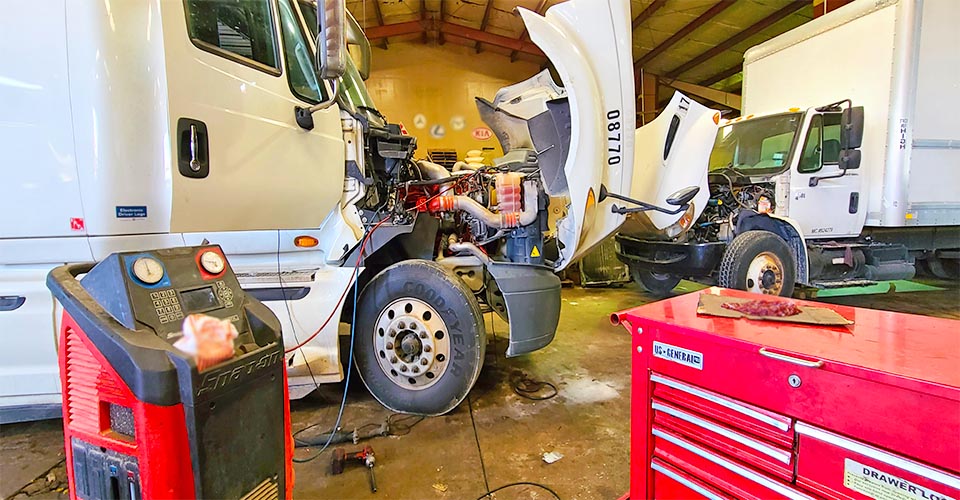
Semi-Truck A/C Repair in Dallas, TX – Why Your System Fails?
Looking for fast and reliable semi-truck A/C repair in Dallas, TX? A/C failures in heavy-duty trucks usually stem from compressor breakdowns, refrigerant leaks, low refrigerant charge, condenser airflow restriction, or electrical malfunctions. In the DFW Metroplex summer, these problems compound quickly — cab interior temperatures hit 130-140°F within 15 minutes when AC fails on hot asphalt. Our experienced diesel mechanics in Dallas specialize in emergency semi-truck A/C repair, EPA Section 609 certified refrigerant service, and preventive maintenance to keep your cabin cool and your fleet on the road across I-20, I-30, I-35 and Loop 12.
Why A/C Isn't Optional on a Texas Class 7-8 Trucks
In Dallas-Fort Worth summer, an out-of-service A/C isn't just a comfort problem — it's a safety, retention and revenue problem. Drivers running I-20 between Tyler and Fort Worth in July face dehydration, fatigue and heat-stress risk that doesn't exist with a working system. The math is brutal: when a driver quits a fleet over a hot truck, replacement cost runs $5,000 to $10,000 per seat — not counting the lost loads while the seat is empty. AC failures rank in the top three reasons drivers leave fleets during summer months in Texas, ahead of pay disputes and home time.
Beyond driver retention, FMCSA hours-of-service compliance requires drivers to sleep in safe conditions. A 100°F+ sleeper compromises rest and creates fatigue-related safety liability the next day. That's why APU bunk A/C systems aren't optional equipment in Texas — they're operational infrastructure.
Key Indicators of Truck Air Conditioning Problems
When you notice unusual cabin temperatures, weak airflow, or strange noises, it's time for a semi-truck A/C diagnostic service in Dallas. Early detection saves fleets from costly breakdowns and ensures your drivers stay comfortable during long hauls. The most common symptoms our Dallas shop sees:
- Warm air from vents — A/C blows ambient or only slightly cool even on max. Usually low refrigerant from a slow leak.
- Cooling drops out at idle — Works on the highway but loses cooling in DFW traffic. Condenser airflow or fan engagement issue.
- Compressor noise on engagement — Squealing, clattering or grinding when AC clutch engages. Clutch or internal bearing wear.
- Water on cab floor — Wet passenger-side carpet means evaporator drain clogged or evaporator core leaking.
- Weak airflow even when cold — Blower motor, cabin filter restriction, or blend door actuator failure.
- Musty or sweet smell from vents — Mildew on evaporator (musty) or coolant migrating from heater core (sweet).
- Bunk AC won't cool — APU sleeper system runs independently of cab AC. Separate diagnostic path.
- AC won't engage at all — Compressor clutch doesn't engage. Electrical, low-pressure cutoff, fuse, or HVAC control fault.
Semi-Truck A/C Leak Repair & Compressor Replacement
Leaks from hoses, seals, condenser corrosion and evaporator pinholes are common in diesel truck A/C repair. Exposure to harsh road conditions, vibration, and Texas heat makes things worse over time. Our Dallas shop offers semi-truck AC compressor replacement, condenser repair, evaporator service, and leak detection using multiple methods: electronic sniffer for ambient detection, UV dye injection for cumulative tracing, soap-bubble for confirmation, and pressure-decay testing for vacuum integrity. OEM and aftermarket parts backed by warranty.
A critical point on compressor replacement: replacing a failed compressor without flushing the lines and replacing the receiver/drier is a common mistake that destroys the new compressor within months. We don't cut that corner. Every compressor replacement includes full system flush, new drier, oil charge match to compressor specification, complete evacuation, and weighed recharge to OEM spec.
Emergency Same-Day Semi-Truck A/C Repair Dallas, TX
Stuck on the road with no cold air? Our emergency semi-truck A/C repair service in Dallas provides fast on-shop fixes for 18-wheelers, commercial trucks, and fleet vehicles. From semi-truck fleet A/C maintenance to full system replacements, we're your trusted partner in keeping your trucks running cool. Most same-day jobs are completed when trucks arrive before noon — refrigerant diagnostic and recharge in 90 minutes to 2 hours, compressor replacement in 3-4 hours, condenser/evaporator service in 4-6 hours.
During peak Texas summer (June through September), AC repair shops across DFW book out 1-2 weeks. Fleet customers on our pre-season program get priority bays during these periods — because a driver with a hot truck isn't waiting two weeks.
Sounds and Symptoms: Diagnosing a Faulty Truck A/C Condenser
A noisy A/C, reduced cooling efficiency, and excessive pressure loss are key indicators of a condenser issue in your semi-truck. The condenser sits in the front of the truck immediately ahead of the radiator — exposed to bug strikes, rocks, debris and road grime that progressively reduce its airflow capacity. Common condenser failures include physical damage (rock strike, leaking fins), corrosion (especially on coastal trucks), restricted airflow (debris buildup between condenser and radiator), and tube cracking from vibration fatigue.
Diagnostically, a failing condenser shows up as: high pressures on both sides of the system when measured at the gauge manifold, vent temperatures that recover slowly when the truck moves to highway speed, and cooling drop-off at idle in Dallas summer traffic. Pressure differential confirms the diagnosis — a condenser that can't dump heat shows abnormal high-side pressure with limited low-side drop. These signs suggest a thorough inspection and possible replacement to ensure your system operates at its best.
Spotting Issues with Your Truck's A/C Compressor
Identifying a malfunctioning A/C compressor involves checking for specific signs such as blown fuses (electrical short or seized clutch), gas leaks at the shaft seal (refrigerant escape), oil leaks at the compressor mount (PAG oil weeping), or audible noise on clutch engagement (bearing failure or internal damage). These symptoms suggest an immediate need for professional assessment and potential repair to ensure your system's optimal performance and durability.
Compressor diagnosis isn't always replacement. We isolate clutch failure (replaceable with the compressor in place), shaft seal failure (sometimes serviceable depending on compressor model), and internal damage (requires full compressor replacement plus system flush). Owner-operators with a $2,000 compressor decision deserve clear information about whether the failure is in the clutch or the internals.
A/C Service by Truck Make — Dallas Heavy-Duty
Each OEM has unique A/C system architectures and common failure patterns. We follow factory specifications and known service procedures for every make on the road in DFW:
- Freightliner (Cascadia, Columbia, M2) — Cascadia condenser is sensitive to road debris on front-end exposure. Evaporator core access on Columbia requires partial dashboard removal. M2 vocational cab has documented blend-door actuator wear.
- Peterbilt (579, 567, 389) — AC fan shroud design on 579 affects condenser airflow at idle. The 389 hood-mounted compressor location complicates belt service. 567 vocational has reinforced clutch assemblies.
- Kenworth (T680, T880, W900) — T680 integrated cabin HVAC computer requires diagnostic scan for blend-door faults. T880 vocational AC sees harder duty cycles. W900 traditional architecture allows easier component access.
- Volvo (VNL, VNR, VHD) — VNL refrigerant capacity is sensitive to recharge accuracy — undercharge or overcharge by 4-6 oz causes performance issues. VHD vocational systems use heavy-duty compressors with extended service life.
- Mack (Anthem, Granite, Pinnacle) — Shares Volvo HVAC architecture (same parent company). Granite vocational AC sees frequent condenser airflow restriction from construction site debris. Anthem has known evaporator drain placement that benefits from periodic clearing.
- International & Western Star (LT, HV, ProStar, 4900, 49X) — International LT has documented evaporator leak pattern at 200,000+ miles. ProStar legacy systems use older R-134a architecture. Western Star vocational chassis tolerates duty cycles others don't.
Cab A/C vs Sleeper Bunk APU — Two Independent Systems
Class 8 trucks with sleeper berths typically have two separate A/C systems: the engine-driven cab AC that runs while the engine is on, and an auxiliary system that cools the bunk during stationary sleep periods. They are independent circuits with independent diagnostic paths.
The cab A/C is powered by a belt-driven compressor when the engine is running, cools the driving cab during operation, and shares the HVAC box with the heater core. Failure means hot cab while driving — an immediate operational issue. With Refrigerant R-134a.
The sleeper APU / bunk A/C is powered by an auxiliary power unit (Thermo King, Carrier Comfort Pro, Rigmaster, or OEM integrated), cools the sleeper berth during stationary rest periods, and runs on shore power or APU diesel generator. Failure means hot bunk during sleep — driver fatigue and HOS compliance risk. Texas anti-idling laws make APU AC essentially mandatory for fleet sleepers because drivers cannot idle the main engine to run cab AC overnight.
A driver complaint of "cab AC works but bunk doesn't" gets a completely different work order than "neither works" — different systems, different fixes.
10 A/C Components We Inspect on Every Service
A heavy-duty AC system is a closed-loop circuit. One weak component degrades the entire system. Our diagnostic always covers:
- 1. Compressor — Clutch engagement, shaft seal, cycle rate, electrical signal continuity
- 2. Condenser — Airflow restriction, fin condition, fan engagement, corrosion or rock damage
- 3. Evaporator — Cooling efficiency, freeze indicators, drain function, bacterial growth
- 4. Expansion Valve / Orifice Tube — Refrigerant metering, sensor function, internal restriction
- 5. Receiver / Drier — Moisture absorption capacity, age, contamination indicators
- 6. Refrigerant Lines & Hoses — O-ring condition, line crimping, oil residue indicating leak point
- 7. Pressure Switches — Low-pressure cutoff function, high-pressure protection, sensor accuracy
- 8. Blower Motor & Resistor — Speed range, resistor pack continuity, current draw at each setting
- 9. Cabin Air Filter — Restriction level (often overlooked, affects airflow significantly)
- 10. Blend Door Actuators — Position calibration, motor function, HVAC mode selection accuracy
Fleet A/C Programs — Dallas-Fort Worth
Fleet customers receive pre-season AC inspection programs (scheduled April-May before Texas heat arrives), volume pricing on parts and refrigerant, priority scheduling during peak Texas summer (June-September), and documented per-unit AC service history. Pre-season inspection catches slow leaks, weak compressor performance and condenser airflow restriction while temperatures are still manageable — and before the entire fleet needs service simultaneously in July.
Service history records the refrigerant amounts, components replaced, and leak history per unit — useful for trade-in valuation, warranty claims, and identifying repeat failure patterns across the fleet. Talk fleet plans at 214-761-9082.
Serving Dallas-Fort Worth & DFW Freight Corridors
Our shop at 2323 Chalk Hill Rd is positioned for easy access from every major DFW highway. We serve owner-operators and fleets across Dallas, Fort Worth, Arlington, Irving, Garland, Mesquite, Grand Prairie, Lewisville, Hutchins and Wilmer — with quick reach from I-20, I-30, I-35E, I-35W, I-45, Loop 12, I-635, and US-67. We also support drayage operators near the BNSF Hutchins and UP Wilmer intermodal terminals.
What's Included & Pricing Transparency
Heavy-duty A/C repair pricing varies by service type and systems because the parts it 4-6x more expensive. We provide written estimates before any chargeable work begins.
Every A/C service includes: full diagnostic with vent temperature, system pressures, compressor cycle check, visible component inspection, documented refrigerant recovered and recharged by weight, written estimate before any component work, final vent temperature verification post-service, and service history record entry for fleet documentation. Additional charges may apply for component replacement, refrigerant cost variance, O-ring kits, receiver/drier, APU AC service, or electrical diagnostics depending on the diagnosis.
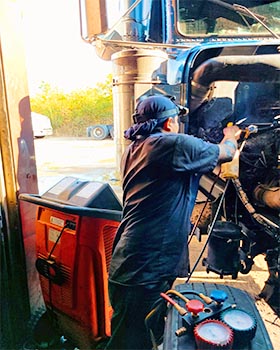
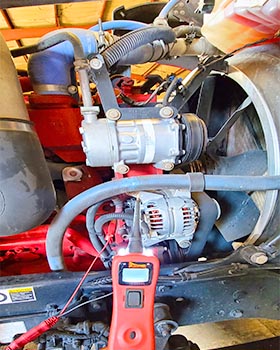
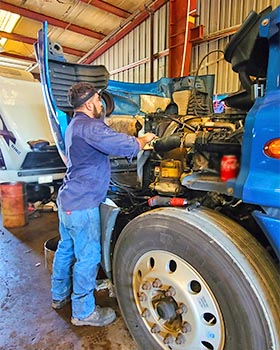
Semi-Truck AC System Repair FAQs
Over time, issues like low refrigerant from a slow leak, a faulty compressor clutch, a clogged condenser, or a stuck expansion valve can cause your truck's AC to blow hot air. The most common cause in Dallas heat is a slow refrigerant leak at the compressor shaft seal, condenser corrosion, or hose O-rings. At Salazar Semi-Truck Repair Inc., we offer full diagnostics with leak detection and quick fixes to restore cold air fast — even during long hauls on I-20, I-30 and I-35.
Signs of compressor failure include loud noises (squealing, clattering or grinding when AC engages), weak airflow even on max setting, no cool air at all, or the AC clutch failing to engage. If your AC system fails to activate or cool consistently after a recharge, your compressor may be worn out. Our expert techs in Dallas can inspect, diagnose and replace faulty compressors quickly — typically same-day.
Weak airflow often points to a clogged cabin filter, blower motor failure, blower resistor pack issue, blend door actuator failure, or restricted evaporator core. We offer same-day inspections to pinpoint the problem and get your cabin cool again. Cabin filter restriction is the cheapest and most overlooked cause.
A properly sealed AC system shouldn't need recharging on a fixed schedule — it should only need recharging when a leak occurs. Most heavy-duty trucks benefit from an annual AC performance check (April-May before Texas summer arrives) to verify refrigerant level, system pressures, compressor cycle, and condenser airflow. Catching a slow leak in May costs $300; replacing a seized compressor caused by running the system empty costs $1,500-$3,000.
We provide on-shop emergency AC services throughout the Dallas area for owner-operators and fleets. Whether you're stuck with no cold air or facing a refrigerant leak, our team is ready to get you back on the road quickly. Same-day intake is standard, and we coordinate with towing companies on I-20, I-30, I-35 and Loop 12 corridors when needed.
We inspect the compressor, condenser, evaporator, expansion valve, blower motor, cabin filter, blend door actuators, pressure switches and refrigerant level. Whether it's a minor leak or full system failure, we offer transparent written estimates and fast service to keep you on the road. Refrigerant recovered and recharged is documented by weight on every job.
Yes. We service auxiliary power unit (APU) A/C systems including Thermo King, Carrier Comfort Pro, Rigmaster and integrated OEM bunk units. APU AC sees harder duty than cab AC because it runs during stationary sleep periods in Texas summer. We diagnose the APU AC separately from the cab system since they're independent circuits.
Yes. Fleet customers receive pre-season AC inspection programs (typically scheduled April-May), volume pricing on parts, priority scheduling during peak Texas summer (June-September), and documented per-unit AC service history. The driver retention math alone justifies fleet AC programs — drivers leave companies over hot trucks faster than over pay disputes, and replacing a driver costs $5,000-$10,000.
Schedule Your Semi-Truck A/C Service in Dallas Today
Call Salazar Semi-Truck Repair Inc. for same-day semi-truck repair in Dallas. We handle fleet truck A/C service, heavy-duty diagnostics, EPA Section 609 certified refrigerant work, and preventive maintenance. Your comfort and uptime are our priority.