
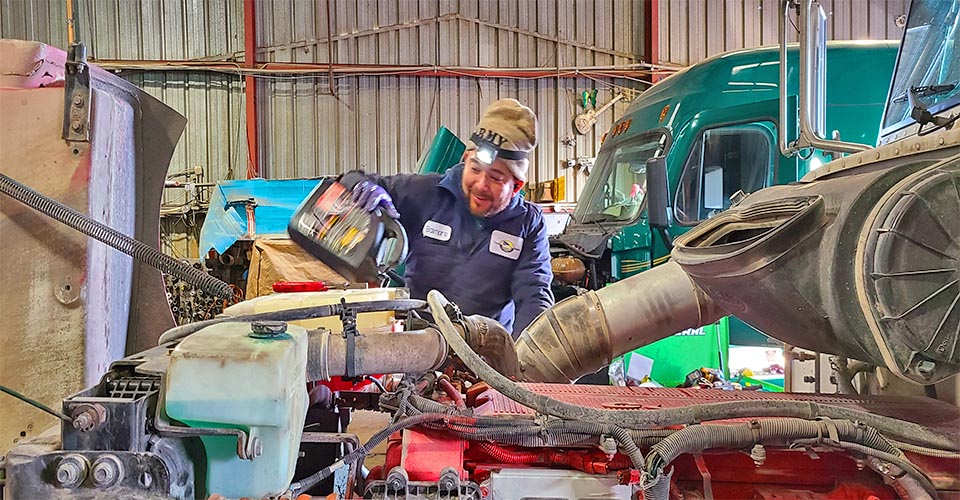
Why does my truck overheat if coolant is full?
Because level is not flow. The system can be full and still fail to move coolant through the radiator and engine due to restriction, pump weakness, fan control issues, or trapped air.
Why does it overheat under load or on hills?
Load increases heat production and requires more airflow and coolant flow. Weak components often look “fine” at idle but fail when demand spikes.
What is the risk if I keep driving?
Overheating can trigger engine protection, derate, shutdown, warped head, coolant contamination, and turbo stress. One event can turn into repeated failures.
What is the safest next step?
Verified diagnostics: pressure test, flow checks, fan control verification, thermostat evaluation, radiator restriction checks, and internal leak detection when needed.
Salazar Semi-Truck Repair Inc. –
2323 Chalk Hill Rd, Dallas, TX 75212
What you are feeling vs what is actually happening
What you feel is the gauge climbing at the worst time. It might run normal at idle, then spike during a route, in traffic, or under load. You check coolant and it looks fine, so it feels confusing.
What is actually happening is usually a flow problem. The cooling system can be “full” but not circulating correctly. When flow drops, temperature climbs fast. Dallas heat, heavy loads, and stop-and-go routes expose weak cooling systems quickly.
Why waiting gets expensive fast
- Engine protection: modern engines reduce power or shut down to prevent catastrophic damage.
- Head and gasket risk: repeated overheating can warp surfaces and create internal leakage.
- Turbo and aftertreatment stress: heat affects everything downstream, including emissions components.
- Downtime escalation: a small flow issue turns into towing, missed loads, and longer repair cycles.
Real causes of overheating with full coolant
When coolant is full but temperatures rise, these are the most common root causes we see:
- Restricted radiator: external debris, bent fins, or internal clogging reducing heat transfer.
- Weak water pump: worn impeller or mechanical failure reducing circulation under load.
- Thermostat issues: stuck partially closed, slow opening, or incorrect temperature control.
- Fan clutch or fan control faults: the fan does not engage properly when it must.
- Air pockets: trapped air after coolant work, leaks, or improper bleeding reducing circulation.
- Hoses collapsing under suction: soft hoses can restrict flow at higher RPM.
- Internal leakage: combustion gases entering coolant, or coolant entering cylinders, especially after repeated overheating.
How we diagnose overheating in Dallas (diagnostics first)
- Pressure test: confirm leaks and pressure stability.
- Flow and restriction checks: radiator condition and coolant movement, not just level.
- Fan engagement verification: confirm command and mechanical response.
- Thermostat evaluation: verify correct operation under real temperature conditions.
- Internal leak detection when needed: combustion gas testing and system verification after repeated events.
When you should stop driving immediately
Overheating is one of the fastest paths to a major repair. Stop and call when any of these happen:
- Temperature rises rapidly and does not stabilize
- Derate activates or power drops while temperature climbs
- You smell coolant, see steam, or notice pressure pushing coolant out
- The fan never engages when the gauge rises
- Overheating repeats after topping off coolant
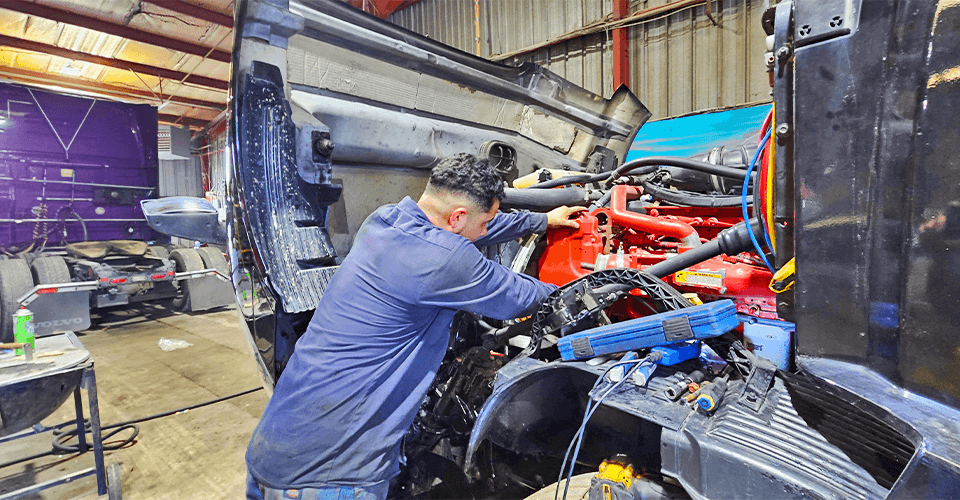
Semi-Truck Overheating – FAQ
Overheating under load usually means the cooling system cannot meet higher heat demand. Common causes include a weak water pump, restricted radiator airflow, clogged internal radiator passages, a failing fan clutch, or hoses collapsing at higher RPM. These issues can look normal at idle but fail when the engine is working hard.
Yes. Coolant level does not guarantee circulation. A worn or damaged water pump impeller may not move coolant effectively under load, causing temperature spikes while the reservoir still appears full.
Overheating in traffic often points to airflow problems. The fan clutch may not engage correctly, the radiator could be externally blocked by debris, or airflow through the cooling stack may be restricted. At highway speed, natural airflow can temporarily mask the weakness.
Yes. A thermostat that sticks partially closed can run fine at light load but restrict coolant flow during higher demand. This can trigger repeated overheating events that feel random until the thermostat is verified.
Common causes include internal restriction, trapped air pockets, fan engagement failure, radiator blockage, head gasket leakage, or combustion gases entering the cooling system. These can raise temperatures without an obvious external leak.
No. A temporary drop does not mean the issue is resolved. Repeated overheating increases the risk of warped cylinder heads, head gasket failure, turbo damage, and engine derate. Early diagnostics reduce downtime and prevent repeat failures.
Stop Overheating Before It Turns Into Engine Damage
If your semi-truck is overheating or showing early temperature spikes, do not wait for it to escalate. Heat-related failures can quickly lead to derate, shutdown protection, and costly internal damage if the root cause is not verified.
Contact Salazar Semi-Truck Repair Inc. today for a professional cooling system inspection and engine repair in Dallas.