
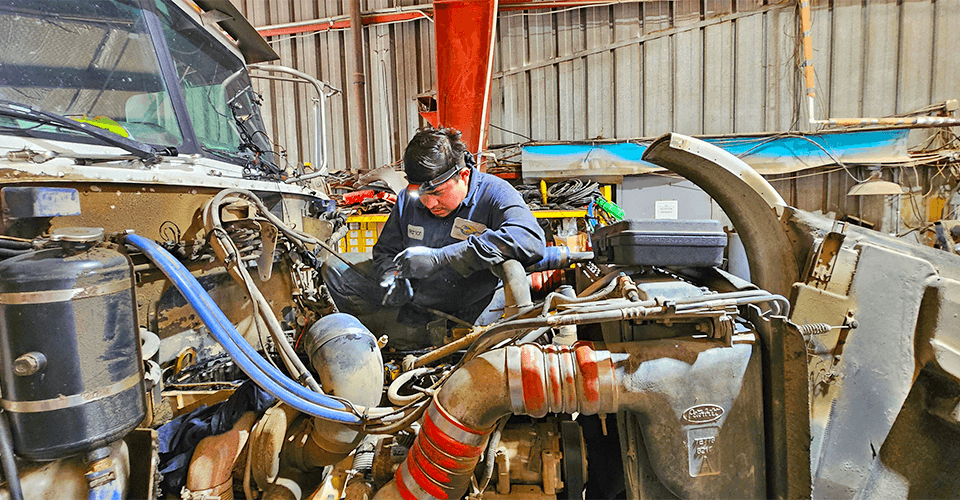
Diesel in Your Coolant Tank? Shut the Engine Down
You're One Drive Away From a Cracked Head or Hydro-Locked Cylinder
If you opened the overflow tank and saw a diesel film floating on the coolant, smelled fuel coming from the radiator cap, or noticed the coolant level dropping with no visible leak — fuel is migrating from inside the engine into the cooling system. This is not contamination from outside. This is an internal failure.
On most heavy-duty diesels the cause is a failed injector cup, a cracked cylinder head or a head gasket breach. Every minute the engine runs spreads diesel through the radiator, heater core and EGR cooler — and risks hydro-locking a cylinder. We diagnose and repair fuel-to-coolant leaks the same day for owner-operators and fleets across Dallas–Fort Worth.
Salazar Semi-Truck Repair Inc. — 2323 Chalk Hill Rd, Dallas, TX 75212
Why Drivers and Fleets Bring Diesel-in-Coolant Trucks Straight to Salazar
- Heavy-duty diesel specialists: Daily diagnostics on Cummins ISX/X15/ISL/ISC injector cup failures, Detroit DD13/DD15 head issues, head and gasket repairs.
- Heavy-duty only: No cars, no light trucks — just semi-trucks, box trucks and commercial fleets.
- Cylinder leakdown and pressure testing: We isolate the failed cylinder before pulling the head — no guesswork, no unnecessary teardown.
- Injector cup replacement experience: Cummins ISX cup failures are a textbook job for our shop. We carry the special tooling required.
- Full cooling system decontamination: Flush, hose inspection, heater core check and refill — the contamination has to come out, not just the source.
- Written estimate before teardown: You know the scope before any major work begins.
- Fleet-friendly documentation: Unit numbers, mileage, fault codes, fluid analysis results, parts replaced and PM recommendations on every repair.
What "Diesel in the Coolant" Actually Means
On a heavy-duty diesel, the fuel system and the coolant system are physically separated by very thin tolerances inside the cylinder head. When something fails between them, fuel — which is at much higher pressure than coolant — pushes through the breach and contaminates the cooling system. The fuel does not come from a leaky cap, a bad fill or an outside contamination. It comes from inside the engine, and the engine is telling you a major component has failed.
On most heavy-duty diesels the failure shows up at one of three places:
- Injector cups (sleeves): the brass or stainless sleeve that seals the injector against both the combustion chamber and the surrounding water jacket. When the cup cracks or its seals fail, fuel pushes directly into the coolant.
- Cylinder head cracks: a fatigue crack between a fuel passage and a water jacket allows continuous bleed-through.
- Head gasket breach: a section of the gasket between fuel and coolant passages fails, allowing migration in either direction.
The Real Causes of Diesel in the Coolant by Engine Family
We see this failure across every major heavy-duty platform, but the textbook cause varies by engine. Knowing the engine narrows the diagnosis from the first phone call.
- Cummins ISX, X15, ISL, ISC: Failed injector cups (also called sleeves) are by far the most common cause. The cup loses its seal between the fuel passage and the water jacket, and high-pressure fuel migrates directly into the coolant.
- Detroit DD13, DD15, DD16: Cracked cylinder heads, particularly between fuel and coolant passages near the injector bores. Head gasket failures are secondary.
- Volvo D11, D13, D16: Injector sleeve failures and head gasket breaches, often after overheating events.
- Mack MP7, MP8, MP10: Similar pattern to Volvo — sleeve and gasket failures, often correlated with overheating history.
- Cat C13, C15, C16, 3406: Cracked heads and failed gaskets — sleeves are less common but possible.
- International MaxxForce 13: Head and gasket failures, with EGR cooler complications adding to the contamination.
Less common but real: a fuel-cooled component (such as a fuel-cooled ECM on certain platforms) leaking internally between its fuel and coolant passages.
How to Confirm It Is Actually Diesel in the Coolant
Before assuming the worst, confirm what you are seeing. Several things can look like diesel in the coolant when they are not:
- Smell test: Diesel has a sharp, distinct odor. Coolant alone smells sweet. If the overflow tank smells like fuel, it is fuel.
- Float test: Pour a sample into a clear container and let it sit five minutes. Diesel separates and floats on top of the water-glycol mix. Oil also floats but has a different texture and color.
- Color check: Diesel contamination often gives the coolant a brown, cloudy or rainbow-sheen appearance. Pure coolant should be its original color (green, pink, orange or red depending on type).
- Level check: If coolant level is dropping consistently with no visible external leak, fluid is going somewhere — either being burned, leaked internally or pushed out by combustion gases.
Once it is confirmed as diesel — not engine oil, not transmission fluid, not coolant degradation — the next step is finding the source. That requires shop diagnostics, not roadside inspection.
What You Should Do Right Now
- Shut the engine down. Every minute the engine runs spreads diesel through the entire cooling loop and increases the risk of hydro-locking a cylinder on the next start.
- Do not drive the truck. Even short distances cause more damage than the tow will cost. Call for a tow if you cannot bring it to the shop on a flatbed.
- Do not flush the cooling system yourself. Flushing without first sealing the source means the fresh coolant is contaminated again within hours.
- Photograph the overflow tank and the coolant sample in a clear container. Send it to us — we can pre-diagnose before the truck arrives.
- Note the engine make, model, mileage and any history of overheating, recent injector work or recent head service. This shortens our diagnosis dramatically.
- Call us at 214-761-9082. We will tell you exactly how to get the truck to our shop without making the damage worse.
How We Diagnose Diesel in the Coolant Step-by-Step
Confirming the source is the difference between a $4k injector cup job and a $15k head replacement. Our process is built to find the actual fault before any major teardown:
- Coolant sample analysis: Visual, smell and float test to confirm fuel vs. oil contamination.
- Cooling system pressure test: Holding pressure on the cooling system to see whether the leak is constant, intermittent or under specific conditions.
- Fuel system pressure decay test: Checking whether high-pressure fuel rails hold pressure with the engine off — falling pressure points to an internal fuel leak.
- Cylinder leakdown test: Pressurizing each cylinder individually to identify which cylinder is leaking into the cooling jacket.
- ECM scan and freeze-frame analysis: Pulling fault codes, misfire history, cylinder cutout test results and any temperature anomalies.
- Visual inspection of injectors and bores: Removing valve covers and inspecting injector seats, hold-downs and visible cup condition.
- Combustion gas test on coolant: Checking for combustion byproducts in the coolant to confirm whether combustion gases are also crossing into the water jacket — this points toward head crack vs. cup-only failure.
- Engine make-specific procedures: On Cummins ISX/X15, the standard protocol is to inspect injector cups first — they are the primary suspect by failure rate.
Symptoms That Usually Show Up Alongside Diesel in the Coolant
- Strong diesel smell from the overflow tank or radiator cap.
- Oily film, brown discoloration or rainbow sheen on the coolant surface.
- Coolant level dropping consistently with no visible external leak.
- White smoke from the exhaust at startup, sometimes with a fuel smell.
- Hard starting or extended cranking after the engine has sat overnight (fuel has migrated into a cylinder).
- Misfire or rough run on a single cylinder under load.
- Cooling system pressurizing more than normal (combustion gases pushing into the jacket).
- Heater core fluid smelling like diesel through the cab vents.
- Recent overheating history that may have warped the head or stressed gaskets.
If you see any of these alongside fuel in the coolant, every additional mile risks turning a cup replacement into a full head job. Stop the truck and call before the next start.
Our Diesel-in-Coolant Recovery Process
- Phone triage: You describe what you see in the overflow tank, the engine make and any history. We pre-diagnose the most likely source before the truck arrives.
- Tow-or-drive decision: We tell you whether the truck is safe to bring in under its own power or whether a tow is the smarter call.
- Confirmation testing: Coolant analysis, cooling system pressure test, fuel system decay test and cylinder leakdown.
- Source isolation: Injector cup, head crack or head gasket — confirmed before any major teardown.
- Written estimate with scope, parts list and timeline before any major work begins.
- Repair of the actual root cause: injector cup replacement, head removal and machining or replacement, gasket and bolt kit installation.
- Cooling system decontamination: Full flush, hose inspection, heater core check, EGR cooler verification and refill with the correct coolant.
- Post-repair pressure tests and supervised run-in to confirm the system holds.
- Fleet documentation: Unit number, mileage, fault codes, fluid analysis, parts replaced, photos of failed components and PM recommendations.
For Drivers
Tell us what you see in the overflow tank, what the engine make is, and whether the truck has overheated recently. You do not need to know whether it is a cup or a head crack — that is our job. Your job is to shut the engine down before the next start makes it worse.
For Owner-Operators
Diesel in the coolant is the most expensive thing to ignore on a heavy-duty diesel. The difference between catching it as a single failed injector cup and catching it as a fully damaged head is often $10,000 or more. We work to confirm the exact failure before we open anything, and to fix it once with the right parts and the right decontamination so it does not come back.
For Fleet Managers
Every diesel-in-coolant repair includes unit number, mileage, fault codes, fluid analysis results, parts replaced, photos of failed components and PM recommendations. If we see a pattern across multiple units in your fleet — for example, repeated Cummins ISX cup failures around similar mileage — we will tell you. Patterns like that often point to coolant chemistry, fuel quality or duty-cycle issues we can help you eliminate fleet-wide.
A Failed Injector Cup Caught Today Is a $4,000 Fix — A Hydro-Locked Cylinder Caught Tomorrow Is a $25,000 Engine
The math on diesel-in-coolant is brutal and simple. Caught early, it is an injector cup replacement and a cooling system flush. Caught late — after fuel has migrated into a cylinder, the truck has been started and a connecting rod has bent against incompressible fluid — it is a full engine rebuild or replacement. The damage scales by the hour, not by the day.
Diagnosing the source today is always cheaper than rebuilding the engine tomorrow.
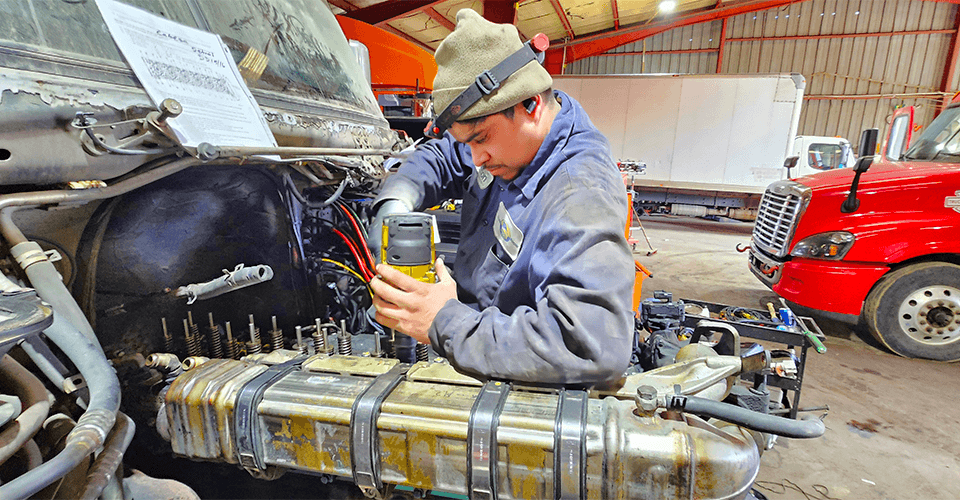
Diesel in Coolant – Frequently Asked Questions
Diesel in the coolant means a fuel-side passage has breached into the water jacket of the engine. On most heavy-duty diesels the cause is a failed injector cup or sleeve, a cracked cylinder head, a failed head gasket or a fuel-cooled component leaking internally. The fuel is coming from inside the engine, and the engine is at risk of severe damage if it keeps running.
No. Continuing to drive accelerates damage to the cooling system, can hydro-lock a cylinder if fuel migrates into the combustion chamber, contaminates the heater core and may destroy the cylinder head if it is already cracked. The truck should be shut down and diagnosed before more damage is done.
On Cummins ISX and X15 engines the most common cause is a failed injector cup, also called an injector sleeve. The cup is the brass or stainless sleeve that seals the injector against both the combustion chamber and the surrounding water jacket. When it fails, fuel pressure pushes diesel directly into the coolant. Cracked heads and failed gaskets are secondary causes.
The most common signs are a strong diesel smell from the overflow tank, an oily or rainbow film on top of the coolant, coolant level dropping with no visible leak, white smoke at startup and sometimes brown or clouded coolant. A simple test is to pour a sample into a clear container and let it sit — diesel separates and floats on top of the water-glycol mix.
The repair cost depends on the underlying cause. Injector cup replacement is the most common scenario and ranges widely depending on engine make and how many cups have failed. A cracked cylinder head requires head removal, machining or replacement, full gasket and bolt kit and cooling system decontamination. We provide a written estimate after diagnosis so you know the exact scope before any major work begins.
Yes, always. Diesel contaminates every component the coolant touches — radiator, heater core, hoses, water pump seals, EGR cooler and aftertreatment cooling lines. After the fuel-side leak is sealed, the cooling system must be fully flushed, hoses inspected, the heater core checked and the system refilled with the correct coolant. Skipping this step shortens the life of every component the contaminated coolant reached.
Same-Day Diesel-in-Coolant Diagnosis in Dallas, TX
Don't crank the engine again. Don't try to flush it yourself. Every start spreads contamination further and risks hydro-locking a cylinder. Call now or have the truck towed to our shop — we will confirm the source, give you a written estimate and repair it once, the right way.
📞 Call Now 📍 Get DirectionsRelated Services and Emergency Pages
- Diesel Engine Repair – Dallas, TX — head, gasket, injector cup and full engine repair (parent service).
- Cooling System Repair – Dallas, TX — full cooling system decontamination and repair (parent service).
- Heavy-Truck Diagnostic – Dallas, TX — cylinder leakdown, ECM scan and pressure testing.
- Coolant in Oil – Dallas, TX — sister symptom, head gasket / oil cooler failure (sibling spoke).
- Fuel Dilution in Engine Oil – Dallas, TX — diesel migrating into the oil instead of the coolant (sibling spoke).
- Oil in Coolant Overflow Tank – Dallas, TX — sister symptom, transmission cooler or oil cooler intrusion (sibling spoke).
- Semi-Truck Radiator Repair — radiator decontamination after fuel exposure.
- Same-Day Semi-Truck Repair – Dallas, TX — emergency repair workflow for stranded units.