
Truck Locked at 5 MPH? You're One Key Cycle Away From No-Restart
We Diagnose and Clear the Inducement Same-Day in Dallas
If your dash is showing "Speed Limited 5 MPH", an amber or red wrench, a DEF light or a check engine light — your truck is in the final stage of EPA aftertreatment inducement.
The next time the engine shuts off, the ECM may not let it restart.
We diagnose the real cause — DEF, SCR, NOx sensors, DPF or EGR — and reset the inducement the same day for owner-operators and fleets across Dallas–Fort Worth.
Salazar Semi-Truck Repair Inc. — 2323 Chalk Hill Rd, Dallas, TX 75212
Why Drivers and Fleets Bring Derate Mode Trucks Straight to Salazar
- Aftertreatment specialists: Daily diagnostics on Cummins ISX/X15, Detroit DD13/DD15, Volvo D13 and Cat C15 inducement faults.
- Heavy-duty only: No cars, no light trucks — just semi-trucks, box trucks and commercial fleets in Dallas–Fort Worth.
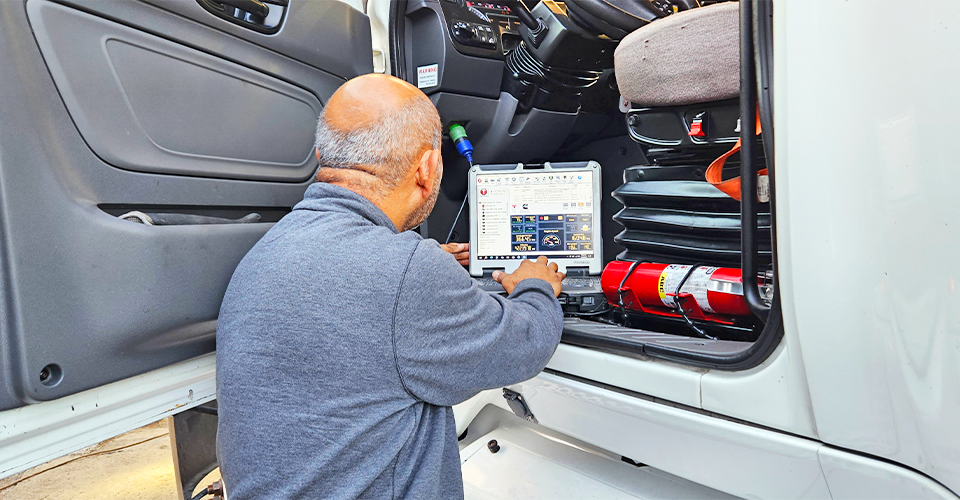
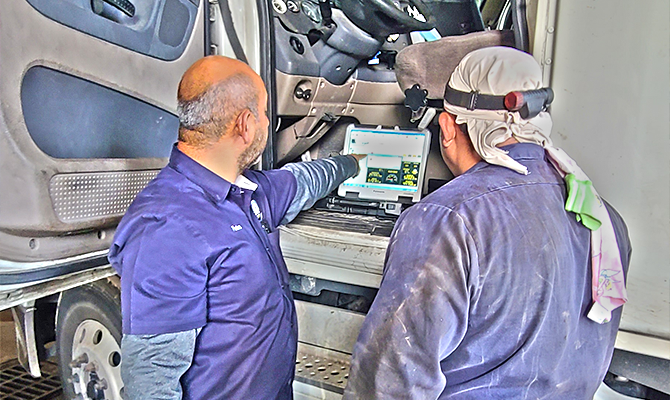
- Dealer-level scan tools: We pull every fault, every freeze-frame and every parameter the ECM has logged — not just the surface code.
- Root-cause approach: A regen alone almost never clears a 5 MPH derate. We isolate which subsystem is actually triggering the inducement.
- Inducement reset: Once the failed component is replaced, we clear the inducement properly so the truck returns to full power.
- Fleet-friendly documentation: Unit numbers, mileage, fault codes, replaced parts, photos and PM recommendations on every repair.
What 5 MPH Derate Mode Actually Means
5 MPH derate is stage 4 of the EPA 2010+ inducement strategy. The ECM has detected a persistent fault in the aftertreatment system and is forcing the truck through escalating restrictions until the driver is compelled to repair it. The progression on most engines looks like this:
- Stage 1: Warning lights only — DEF, check engine or SPN/FMI codes logged.
- Stage 2: Engine torque reduced approximately 25%.
- Stage 3: Engine torque reduced 40–50%, vehicle speed limited to 55 MPH.
- Stage 4: Vehicle speed limited to 5 MPH after the next idle, key cycle or fueling event.
- Stage 5: No-start condition — engine will not crank or will not stay running.
Once the truck reaches the 5 MPH stage, the only path back to full power is to identify the root cause, repair it and clear the inducement with a heavy-duty diagnostic tool. Refilling DEF, restarting the engine or unplugging the battery will not bypass it.
The Real Causes of 5 MPH Derate We See Every Week
On a derate this severe, the fault is almost always in one of five subsystems. Identifying the correct one quickly is the difference between a 2-hour repair and a $10,000 misdiagnosis.
- DEF system faults: low DEF level not detected, DEF quality sensor failure, contaminated DEF, DEF doser injector clogged, DEF pump pressure out of range, DEF heater circuit failure.
- SCR efficiency faults: SCR catalyst degraded, SCR conversion efficiency below threshold, ammonia slip, frozen DEF lines in cold weather.
- NOx sensor failures: upstream (inlet) NOx sensor reading wrong, downstream (outlet) NOx sensor failed, sensor wiring or connector damage.
- DPF and soot-related faults: DPF differential pressure sensor failed, DPF clogged beyond regen capability, soot load incorrectly calculated, regen attempted and failed too many times.
- EGR-side faults: EGR valve stuck, EGR cooler leaking coolant into the exhaust stream, EGR position sensor out of range — all of which corrupt the aftertreatment chemistry and trigger SCR efficiency derates.
Less common but real on older units: ECM software glitches, parameter mismatch after a recent reflash, faulty wiring harness chafe, or a tampered aftertreatment system the previous shop tried to "delete" without a proper return-to-stock.
What You Should Do Right Now
- Get the truck off the highway. 5 MPH derate is unsafe in active traffic. Move to a truck stop, yard, parking lot or shoulder.
- Do not keep cycling the key. Each restart can advance the inducement timer toward the no-start stage on some engines.
- Check DEF level visually, not just the gauge. If the tank is empty, refill — but understand this alone will not clear stage 4.
- Photograph the dash — every warning light, every code, every message in the driver display. Send it to us and we can pre-diagnose before the truck even arrives.
- Call us at 214-761-9082. We will tell you whether the truck can limp to our shop at 5 MPH on side streets or needs to be towed.
How We Diagnose a 5 MPH Derate Step-by-Step
A derate this severe is never solved by reading a single fault code. Our process is designed to isolate the actual root cause on the first visit:
- Full ECM scan: all active codes, inactive codes and freeze-frame data across engine, aftertreatment and chassis modules.
- Fault history timeline: identifying which fault came first — the trigger — versus the cascade of secondary codes.
- DEF quality test: refractometer reading to confirm urea concentration is within spec (32.5%).
- Live data review: NOx sensor values, DEF doser flow, exhaust temperatures, EGR position, soot load.
- Component-level testing: NOx sensors, DEF doser, DEF pump, EGR valve, DPF differential pressure sensor — only after the data points to them.
- Visual aftertreatment inspection: checking for soot leaks, cracked clamps, damaged harnesses and DEF crystallization.
- Inducement reset and confirmed drive cycle after the failed component is replaced.
Symptoms That Usually Show Up Before and Alongside 5 MPH Derate
- Check engine light and DEF light on simultaneously.
- SPN/FMI codes such as 3361, 3364, 3216, 4364, 5246 (codes vary by engine).
- "Speed Limited 5 MPH", "Engine Derate", "See Dealer" or "Stop Engine" messages.
- Truck idles fine but loses power as soon as load is applied.
- Repeated regen attempts that finish but return to derate within a few miles.
- White or sweet-smelling exhaust (DEF crystallization or coolant in the aftertreatment).
- Black smoke under load (EGR or DPF involvement).
If you see any of these and the truck has reached 5 MPH stage, the next idle event is the risk window — get it diagnosed before the engine refuses to restart.
Our Same-Day Derate Recovery Process
- Phone triage: You describe the dash, the lights and what the truck was doing when it derated. We pre-diagnose the most likely subsystem.
- Move-or-tow decision: We tell you whether 5 MPH is safe for limp-in or whether a tow is the smarter call.
- ECM scan and freeze-frame analysis the moment the truck arrives.
- Written estimate before any major part is replaced — no surprises.
- Repair of the actual root cause: NOx sensor, DEF doser, SCR catalyst, DPF service, EGR component, sensor wiring or ECM-side issue.
- Inducement reset with heavy-duty diagnostic software once the repair is verified.
- Drive cycle confirmation so the derate does not return on your way out the gate.
- Fleet documentation: unit number, mileage, codes, freeze-frame, parts replaced, drive-cycle data and PM recommendations.
For Drivers
Tell us exactly what the dash says — every light, every message, every code. We translate that into a real diagnosis without making you decode it. You do not need to know whether it is the SCR or the NOx sensor — that is our job. Your job is to get the truck somewhere safe and call.
For Owner-Operators
Every day in derate is a day not earning. We work to fix the real cause once instead of clearing codes that come back the next morning. Written estimate, photos of the failed part and a drive-cycle confirmation before you leave the shop.
For Fleet Managers
Every derate repair includes unit number, mileage, fault codes, freeze-frame data, parts replaced and PM recommendations. If we see the same DEF or NOx fault patterns across multiple units in your fleet, we will tell you — repeat derates often signal a fueling, DEF supply or driver-behavior issue we can help you eliminate.
Every Hour at 5 MPH Is an Hour You're Not Earning and the Next Key Cycle Could Be Worse
A 5 MPH derate already costs you missed deliveries, late fees, dispatcher calls and a parked truck. The real risk is what comes next: the no-start stage. Once the engine refuses to crank, you are now paying for towing, lot fees, downtime, customer fallout and a more expensive repair — all because a NOx sensor, DEF doser or SCR component never got diagnosed properly.
Fixing the real cause today is always cheaper than waiting until the truck won't start tomorrow.
5 MPH Derate Mode – Frequently Asked Questions
5 MPH derate is the final speed-restriction stage of EPA 2010+ aftertreatment inducement. The ECM has logged a persistent fault — usually DEF quality, NOx sensor, SCR efficiency or DPF — and limits the truck to 5 MPH. If the fault is not corrected, the next stage is a no-restart condition.
Almost never. A forced regen only addresses soot in the DPF. If the inducement is caused by DEF quality, NOx sensors, SCR or DEF system components, a regen will not clear it. The fault must be diagnosed and the inducement reset with heavy-duty software.
Adding DEF only resolves a low-level inducement. At the 5 MPH stage the ECM has already locked in a permanent fault that requires a scan tool to clear. The actual cause is often DEF quality, a failed sensor or a clogged doser — none of which are fixed by refilling the tank.
Driving long distances at 5 MPH is unsafe and can advance the inducement to a no-start condition on the next key cycle. The safer path is to move to a secure location and call a heavy-duty diagnostic shop immediately.
Most derate diagnostics take 1–3 hours. Repair time depends on the failed part — NOx sensors and DEF dosers are typically same-day, while SCR catalyst replacement or DPF cleaning can take longer. We provide a written estimate before any repair begins.
Not if the actual root cause is repaired. Derates return when only one symptom is patched instead of the underlying fault. Our process includes ECM scan, freeze-frame analysis, component testing and a post-repair drive cycle to confirm the inducement does not return.
Same-Day 5 MPH Derate Diagnosis in Dallas, TX
Don't risk a no-restart, a missed load or a tow bill. Call now or bring the truck to our shop — we will scan, diagnose and clear the inducement so you are back at full power today.
📞 Call Now 📍 Get DirectionsRelated Services and Emergency Pages
- Forced Regen Service – Dallas, TX — when soot load is the trigger.
- DPF Cleaning Services – Dallas, TX — for clogged or saturated DPFs.
- Emissions System Repair – Dallas, TX — full DEF, SCR and EGR system service.
- Heavy-Truck Diagnostic – Dallas, TX — dealer-level ECM scan and fault analysis.
- Diesel Engine Repair — when the derate exposes deeper engine issues.
- Same-Day Semi-Truck Repair – Dallas, TX — emergency repair workflow for stranded units.
- Electrical Diagnostic & No-Start Emergency — if the truck has already advanced to no-start.