
Regen Running for an Hour and Still Not Done?
Every Failed Regen Pushes You Closer to Derate We Find Out Why, Today
If your regen aborts halfway, runs without ever finishing, or completes only to trigger again within miles — your truck is not actually clearing soot. It is masking a deeper failure that is pushing you toward derate, no-start, and a much bigger repair.
The fix is never "just run another regen". The fix is finding what is preventing combustion in the first place. We diagnose and repair failed regens the same day for owner-operators and fleets across Dallas–Fort Worth.
Salazar Semi-Truck Repair Inc. — 2323 Chalk Hill Rd, Dallas, TX 75212
Why Drivers and Fleets Bring Failed-Regen Trucks Straight to Salazar
- Aftertreatment specialists: Daily diagnostics on Cummins ISX/X15, Detroit DD13/DD15 and Cat C15 regen failures.
- Heavy-duty only: No cars, no light trucks — just semi-trucks, box trucks and commercial fleets.
- Root-cause first, regen second: A forced regen on a failing system either aborts the same way or fails again within miles. We diagnose before we regen.
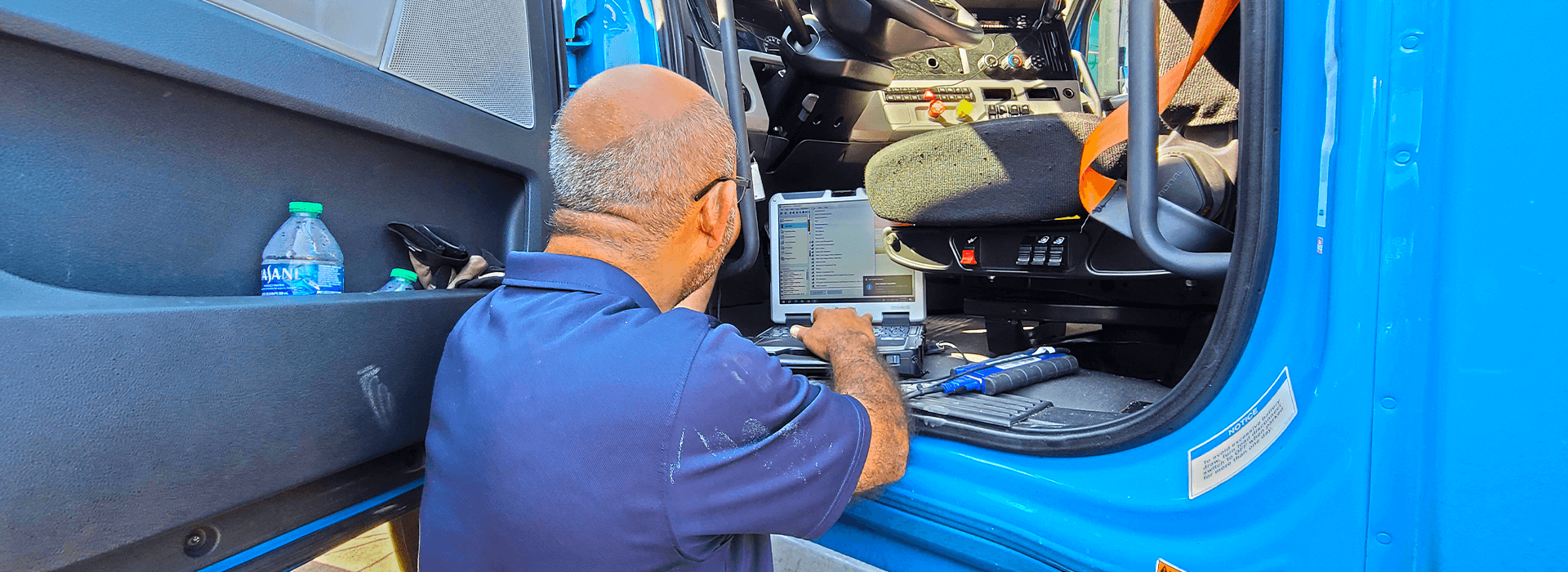
- Dealer-level scan tools: Live data on exhaust temperatures, doser flow, soot load, regen status, NOx values and freeze-frame from every abort.
- Component-level testing: Doser injectors, temperature and pressure sensors, exhaust leak isolation, EGR cooler integrity and DPF condition.
- Fleet-friendly documentation: Unit numbers, mileage, fault codes, parts replaced, supervised post-repair regen confirmation and PM recommendations.
What "Regen Won't Complete" Actually Looks Like
A failed regen is not always obvious from the dash. The symptom shows up in different shapes depending on engine make, soot load and which subsystem is actually faulting. The most common patterns we see in the shop:
- Regen starts and aborts within minutes — exhaust never reaches combustion temperature.
- Regen runs for an hour or more without finishing — temperatures climb but never sustain.
- Parked regen completes "successfully" but the soot light returns within 50 miles — soot is not actually being burned.
- Active regen on the highway never completes the cycle — driver sees the regen icon for hours.
- Multiple parked regens in a single day — each one finishes but the system asks for another almost immediately.
- Regen aborts as soon as the driver shifts, brakes or steps on the throttle — system is hyper-sensitive because conditions are already marginal.
All of these point to the same conclusion: the regen procedure itself is fine — the hardware or sensor data feeding the procedure is not.
The Real Reasons a Regen Won't Complete
On EPA 2010+ engines, regen completion depends on three things working together: enough fuel reaching the doser, enough heat reaching the DPF, and enough sensor accuracy for the ECM to confirm combustion. If any one of these breaks down, the regen aborts or runs forever without finishing.
- Clogged or failed DPF doser injector: The doser cannot deliver the diesel fuel needed to raise exhaust temperatures. Common on units that run low-quality fuel or skip scheduled service.
- Exhaust leak between turbo and DPF: Cracked V-band clamps, blown gaskets or pipe corrosion let heat escape before it reaches the DPF. The ECM sees temperatures that never climb to target.
- Failed exhaust temperature sensor: The ECM is reading wrong temperatures, either aborting a regen that is actually fine or running one that is not actually working.
- Failed DPF differential pressure sensor: Soot load is being calculated from bad data — the truck regens when it doesn't need to or fails to regen when it should.
- EGR cooler leaking coolant into the exhaust: Coolant kills regen temperature and contaminates the DPF. Often shows white sweet-smelling exhaust.
- DPF cracked, ash-saturated or substrate damaged: The filter is no longer capable of being regenerated and must be cleaned off-truck or replaced.
- Excessive idle time and short-trip operation: The engine never reaches the duty cycle needed for active regen, and parked regens compound carbon faster than they clear it.
- Low DEF level or DEF quality issues on engines where SCR efficiency gates regen permission.
- ECM software glitch or parameter mismatch after a recent reflash.
What You Should Do Right Now
- Stop retrying regens. Each failed cycle adds heat and stress to the DPF without clearing it.
- Note exactly when the regen aborts — at startup, after X minutes, when shifting, after a stop. This data shortens our diagnosis dramatically.
- Check for warning lights: DEF, check engine, soot level, "See Dealer", "Engine Derate Soon".
- Visually inspect the exhaust from outside the truck — white smoke, black smoke or audible exhaust leaks all narrow the diagnosis.
- Photograph the dash — every light, every code, every regen-status icon. Send it to us in advance.
- Call us at 214-761-9082. If the truck is still drivable, get it in before the inducement timer escalates.
How We Diagnose a Failed Regen Step-by-Step
Repeated regen failures are diagnostic problems, not procedural ones. Our process is built to find the actual fault on the first visit:
- Full ECM scan across engine, aftertreatment and chassis modules — every active code, inactive code and pending code.
- Freeze-frame analysis from each aborted regen — exact temperatures, RPM, soot load and sensor readings the moment the regen failed.
- Live data review during a controlled regen attempt: doser flow, exhaust inlet/outlet temperatures, DPF differential pressure, NOx in/out, EGR position.
- Doser injector test: flow, spray pattern, electrical signal, fuel supply pressure.
- Exhaust leak isolation: visual, audible and pressure-test inspection from turbo outlet through every clamp and gasket to the DPF inlet.
- Sensor verification: temperature and pressure sensors compared against known-good reference values.
- EGR system check: cooler pressure test for coolant intrusion, valve actuation, position feedback.
- DPF condition assessment: backpressure, ash load, visual inspection — does the filter still pass cleaning, or does it need replacement?
- Supervised regen after repair to confirm the system completes a full cycle and holds.
Symptoms That Usually Show Up Alongside a Failed Regen
- Soot level high warning or rising soot indicator that never drops.
- Check engine light combined with the regen icon.
- Active regen status that has been on for hours of highway driving.
- Truck idles fine but loses power as soon as load is applied.
- White smoke or sweet-smelling exhaust during regen attempts (EGR coolant intrusion).
- Black smoke and a smell of unburned diesel (doser dumping fuel without combustion).
- Higher-than-normal fuel consumption over the past several days.
- Exhaust leak hiss audible from the engine bay or under the cab.
If you are seeing any of these alongside failed regens, you are not far from the next inducement stage. Diagnose now, before the truck gets parked at 5 MPH.
Our Same-Day Failed-Regen Recovery Process
- Phone triage: You describe when the regen aborts, what lights are on, and what the exhaust looks like. We pre-diagnose the most likely subsystem before the truck arrives.
- Move-or-tow decision: We tell you whether the truck is safe to drive in, or whether continued operation will damage the DPF further.
- ECM scan, freeze-frame analysis and live data capture — we recreate the failure conditions in a controlled environment.
- Component testing: doser, sensors, exhaust leaks, EGR cooler, DPF condition.
- Written estimate before any major part is replaced — no surprises, no upsells.
- Repair of the actual root cause, not the symptom.
- Supervised post-repair regen to confirm the system completes a full cycle without aborting.
- Drive cycle confirmation so the regen does not fail on your way out the gate.
- Fleet documentation: unit number, mileage, codes, freeze-frame, parts replaced, regen completion data and PM recommendations.
For Drivers
Tell us what you see — when does the regen abort, what lights are on, what the exhaust looks like. You do not need to know whether it is the doser or the EGR — that is our job. Your job is to stop running back-to-back regens and get the truck in before the soot load goes past the point of recovery.
For Owner-Operators
Every failed regen costs fuel, time and DPF life. We work to fix the real cause once instead of clearing codes and sending you out the door to fail again. Written estimate, photos of the failed component and a supervised regen confirmation before you leave the shop.
For Fleet Managers
Every failed-regen repair includes unit number, mileage, fault codes, freeze-frame data, parts replaced and post-repair regen completion logs. If we see the same regen-failure patterns across multiple units in your fleet — for example, repeated doser failures or EGR cooler leaks on a specific engine family — we will tell you. Repeat regen problems across a fleet often signal a fueling, route-profile or PM-cadence issue we can help you eliminate.
Every Failed Regen Pushes You Closer to Derate — and a Replaced DPF Is 10x More Expensive Than Finding the Real Cause Today
A regen that won't complete is the warning shot. The next stages are torque reduction, 55 MPH speed limit, 5 MPH derate, and finally a no-start condition — at which point you are paying for towing, lot fees, lost loads and a much bigger repair. Worse, every cycle of failed regens accelerates damage to the DPF substrate, turning a sensor or doser repair into a full DPF replacement.
Diagnosing the real cause today is always cheaper than replacing a DPF tomorrow.

Regen Won't Complete – Frequently Asked Questions
A regen that will not complete almost always means the truck cannot reach or hold the temperatures needed to burn soot. Common causes are a clogged doser injector, an exhaust leak before the DPF, a failed temperature or pressure sensor, a cracked or ash-saturated DPF, an EGR cooler leaking coolant into the exhaust, or excessive idle time that prevents the engine from warming enough to start the regen.
The ECM aborts a regen when it sees unsafe conditions — exhaust temperatures too low, sensor data out of range, the driver shifting or braking during a parked regen, soot load too high to combust safely, or a fault in the doser, DPF, EGR or NOx sensors. The fix is to find what the ECM saw and repair the underlying component, not to keep retrying the regen.
An active regen on the highway usually completes in 20 to 45 minutes. A parked regen takes 30 to 60 minutes. If your regen runs longer than an hour, cycles multiple times in a day, or finishes only to retrigger within miles, the system is masking a deeper failure that needs diagnosis.
You can drive short-term, but every failed regen pushes the truck closer to engine derate and damages the DPF further. Most engines escalate from check engine light to torque reduction, 55 MPH limit, 5 MPH derate and no-start. The smart move is to diagnose the cause before the inducement timer advances.
A forced regen only helps if soot load is the only issue. If the underlying cause is a failed doser, exhaust leak, sensor fault, cracked DPF or EGR problem, the forced regen will abort the same way or complete and fail again within miles. We find the root cause first, repair it, then run a supervised forced regen to confirm full system recovery.
An active regen happens automatically while driving on the highway when exhaust temperatures are high enough to burn soot. A parked regen is initiated by the driver when soot load is too high for an active regen — the truck is stationary while the ECM raises temperatures using the doser. Both can fail for the same reasons. If neither completes, the issue is hardware or sensor, not procedural.
Same-Day Failed-Regen Diagnosis in Dallas, TX
Don't keep retrying regens that will not complete. Each cycle damages the DPF and pushes you closer to derate. Call now or bring the truck to our shop — we will find the real cause, repair it, and confirm a full regen cycle before you leave.
📞 Call Now 📍 Get DirectionsRelated Services and Emergency Pages
- Forced Regen Service – Dallas, TX — supervised forced regen after root-cause repair.
- DPF Cleaning Services – Dallas, TX — for ash-loaded or saturated DPFs that no longer regenerate.
- Emissions System Repair – Dallas, TX — full DEF, SCR and EGR system service.
- Heavy-Truck Diagnostic – Dallas, TX — dealer-level ECM scan and freeze-frame analysis.
- Stuck in 5 MPH Derate Mode — if failed regens have already escalated to derate.
- Diesel Engine Repair — when the regen failure exposes deeper engine issues.
- Same-Day Semi-Truck Repair – Dallas, TX — emergency repair workflow for stranded units.